Unit V Lesson 1
Laplace Transform
Introduction and definition Laplace transform, non-standard driving functions, solving from the algebra domain. 
Laplace transform examples, f(t)=1, f(t)=t.
Laplace transform examples f(t)= et and f(t)= sin(2t).
Laplace transform is a linear operator, an example, a book error in 7th edition, small table of transforms.
Laplace transforms existence, example of a transform of a piecewise defined function.
Laplace transforms example using linearity of transform.
In the linear second order model for spring/mass systems and series electric
circuit, the right hand side of the equations

is a ‘driving function’ representing some external force f(t) or
an impressed voltage E(t). Piecewise continuous driving functions are not
uncommon. For example, the driving function could be described graphically
by either of the following:

We have no direct method of solving problems of this nature. The problems
can often be solved with transform methods, and the one we will focus on
is the
Laplace transform.
We won’t be solving any differential equations this way until we are
into Unit V Lesson 5. Before then, we need to learn how to make transforms
as well as inverse transforms of various functions. The picture below tells
the story of how solving equations is done. For the rest of this section
and the next three as well, we will be learning how to transform and find
inverse transforms of functions (the sideways arrows in the picture).

Laplace transform method can also be used to solve systems of equations.

Def: Laplace transform: If f is a function defined
for  , the Laplace
transform of f(t), denoted
L{f(t)}, is defined as
L{f(t)}=
, the Laplace
transform of f(t), denoted
L{f(t)}, is defined as
L{f(t)}= provided that the improper integral converges.
Note that it is a function of s. That is,
L{f(t)}=F(s).
Note the familiar notation of capitalizing to show an antiderivative.
Example Find
L{1}.
Solution:

Recall an operator M is linear if M{Af(x)+Bg(x)}=AM{f(x)}+BM{g(x)}.
Note that the Laplace transform is a linear operator since integration
is linear:

Ex1. Find
L{t+2}
Take this link after trying it yourself.
Ex2. Find
L{e2t} (easier!)
Take this link after trying it yourself.
A natural question arises, especially since a simple function requires
complicated calculation to find its Laplace transform. Does the Laplace transform
always exist for a function?
Def: Exponential order
A function f is said to be of exponential order C if there are constants
C, M>0, and T>0 such that
 for all t >T.
If f is an increasing function, being of exponential order C>0 means that
the graph of f doesn’t grow any faster than the graph of MeCt
for t>T.
If f is a decreasing function, being of exponential order C<0 means that
the graph of f lies below the graph of MeCt for t>T.
Theorem: Sufficient conditions for existence If
f(t) is piecewise continuous on [0, infinity) and of exponential order C
for t>T, then L{f(t)} exists for
s>C.
The proof is in the book and relies on showing that the integral representing
the Laplace transform is convergent if is of exponential order C.
It requires comparing the integral representing the transform and the integral
of MeCt.
Note that L{f(t)} doesn’t exist
for f(t)=1/t or f(t)=exp(t2).
Example Show that
L{tn}=n!/sn+1.
Solution: With u=tn and du=ntn-1, dv=e-st
and v=-e-st/s using integration by parts,

The first part of this can be shown to be zero with n+1 applications of
L’Hopital’s rule.
Now we have to evaluate

The same process will continue, with the last integral representing
L{1}=1/s from the preceding example
.
Example Find
L{sin(kt)}
L{sin(kt)}=
The integration on the first step was by parts with u=sin(kt), du=kcos(kt),
dv=e-stdt, v=-(1/s)e-st.
The u*v part=0 since sin(0)=0. Continue on with the remaining integral:
L{sin(kt)}= 
The integration on the first step was by parts with u=cos(kt), du=-ksin(kt),
dv=e-st, v=-(1/s)e-st .
The u*v part is k/s2 (If you work out the limit at infinity,
it’s zero. cos(0) and e0 are both 1, so we have –(-1).
The problem is now at this stage:
 .
.
This equation can be solved for the desired integral:

So we see that
L{sin(kt)}= .
.
As an assignment, you will be asked to work out
L{cos(kt)}. It is similar.
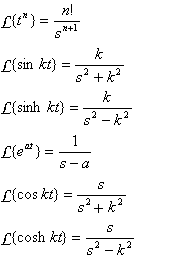
The following table is a very short list of common Laplace transforms:
Piecewise defined functions also have Laplace transforms as the following
example shows:
Example Find the Laplace transform of f(t)
where

Solution:
Since the function is piecewise defined, we look at the three integrals:

There is no need to memorize the transform chart. I’d like you to come
away from this session with an overview, the definition of the transform,
and review some integration skills from calculus class.
Once we know a few rules for transforms, we can use the linearity of the
Laplace transform to work out problems with ease.
Example Find
L{f(t)}where
f(t)=3t2+sint
Solution:
L{3t2}=3(2!)/s3
and L{sint}=1/(s2+1), so
we have
L{3t2+sint
}=
Now you try one:
Ex3. Find L{f(t)}
where f(t)= t-7-cosht
Take this link after you’ve tried it yourself.
****assignment****
Chapter 7 Section 1
Problems 1,3,9,19-37 odds using table and linearity of Laplace transform,
and show
L{cos(kt)}=s/(s2+k2)