15.2 Line Integrals
Line integrals over smooth curves, a parametrization for a piecewise smooth curve.


What is a line integral? Line integral as a sum.
Line integrals in R2 and R3 and similarity to arc length if common density is 1
Two examples of line integrals.
Another example.
Another example, finding the mass of a spring.
Line integrals in vector fields, projection and dot product.
Line integral in a vector field and an example.
A line integral done in both directions with expected result and also different parametrizations.
Line integrals in vector field notation, revisted example.
Piecewise Smooth Curves
One of the properties of gravitational fields is that the work done by a
gravitational field on an object moved between points is independent of the
path of the object under certain conditions.  One of the conditions is that the path must be piecewise smooth. Recall
the plane curve C given by
One of the conditions is that the path must be piecewise smooth. Recall
the plane curve C given by is
smooth if dx/dt and dy/dt are continuous on [a,b] and are not simultaneously
0 on (a,b). Similarly a space curve
is
smooth if dx/dt and dy/dt are continuous on [a,b] and are not simultaneously
0 on (a,b). Similarly a space curve  is
smooth if dx/dt,dy/dt and dz/dt are continuous on [a,b] and are not simultaneously
0 on (a,b).
is
smooth if dx/dt,dy/dt and dz/dt are continuous on [a,b] and are not simultaneously
0 on (a,b).
A curve C is piecewise smooth if the interval [a,b] can be partitioned into a finite number of sub-intervals, on each of which C is smooth.
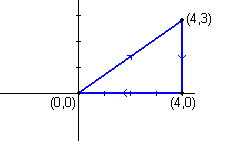
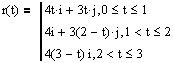
Ex 1 Find a piecewise smooth parametrization of the curve C in the sketch:

Line Integrals
Up to now in calculus, you have studied single integrals over intervals
like this:  and multiple
integrals over regions like this:
and multiple
integrals over regions like this: 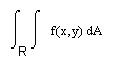 .
.
In this section we will look at a new type of integral called a line integral and some applications of line integrals. Line integrals are notated like this:

The integration takes place not over an interval or a region, but over a piecewise smooth curve C like the example above. Consider the mass of a wire of finite length given by a curve C in space. Suppose the density of the wire at (x,y,z) is given by f(x,y,z). If we partition the curve C into 'subarcs' by inserting points P0, P1, P2, ...Pn along the wire and let the length of the ith subarc be called Dsi. Choose a point (xi,yi,zi) in each subarc and represent the density of the wire on the entire subarc with f(xi,yi,zi). The mass of the wire can be approximated by the following:

If we let  (the
'norm' of the partition) represent the length of the longest subarc, then
the limit of this sum as
(the
'norm' of the partition) represent the length of the longest subarc, then
the limit of this sum as  approaches
0 is the mass of the wire.
approaches
0 is the mass of the wire.
Def Line Integral (2D and 3D)
If f is defined in a region containing a smooth curve C then the line integral of f along C is given by
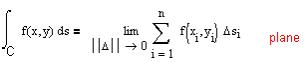
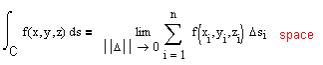
provided that the limit exists.
How are such line integrals evaluated? Just as in integration over a region, we need to convert to a definite integral. Here's the theorem:
Theorem 15.4 Evaluation of a Line Integral as a Definite Integral
Let f be continuous in a region containing a smooth
curve C. If C is given by  where
where
 ,
then
,
then
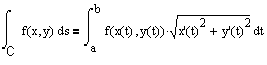
If C is given by  where
where
 ,
then
,
then

Note that if f(x,y,z) = 1 or f(x,y) = 1, then we have the arc length of the curve as defined in unit II lesson 5. (Or even in Calc II. Note the 'arc length' part of the integral in each formula above is the part under the radical.)
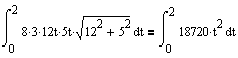
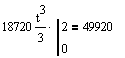
Ex 2 Evaluate the line integral over the indicated
path:  C is the curve r(t) = 3i+12tj+5tk
Ex 3 Evaluate the line integral along the given
path: 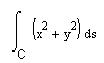
C is the curve from (2,0) to (0,2) counterclockwise on the circle x2 + y2 = 4.
r(t) = 2cos(t)i
+ 2sin(t)j for  .
.
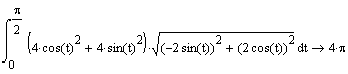
Note that for any parametrization in the form r(t)=x(t)i+y(t)j+z(t)k, that in the line integral formula,

Therefore another way of writing the line integral could be

Ex 4 Evaluate the line integral over the curve:
 where
C is the curve described by the vector valued function
where
C is the curve described by the vector valued function 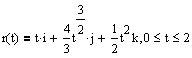

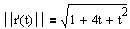
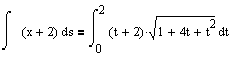
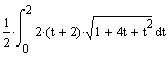
If we let u = 1 + 4t + t2 we get the following:
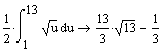
The numerical answer is  .
.
Ex 5 Find the mass of the spring in the shape of the circular helix given by vector valued function r(t) if the density of the wire at the point (x,y,z) is f(x,y,z) = z + 1.



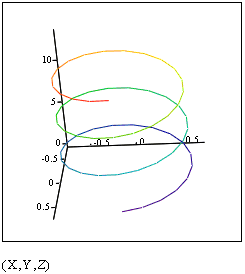

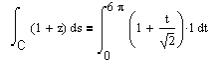
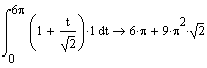
Numerically the spring has mass  .
.
Line Integrals of Vector Fields
An important application of line integrals is finding the work done when moving an object over a force field. An example of an object in an inverse square field might be figuring out how much power is needed to launch a rocket into space, or beyond the gravity pull of Earth. The farther from the Earth, the less for is required to move the rocket. A line integral along its path might be able to find the necessary fuel load for the rocket launch.
To see how a line integral may be used for this, think about a force field F and consider an object moving along a path C in the field. To calculate the work, one needs only to consider the work done by the force in the same direction as the curve, (or in the opposite direction if it is opposed). Therefore at each point on the curve, you need only to consider the projection of the field F onto a unit vector in the direction of the curve, call it T, of the vector valued function describing C. On a small subarc of length Dsi, the incremental amount of work for moving along the subarc is DWi where


for (xi,yi,zi) some point in the ith subarc. Consequently the total work done moving along the curve C in the force field F is given by the integral:

This line integral appears in other applications and is the basis for this definition of the line integral of a vector field. With a little manipulation, we can alter the look of it as follows:



Def Line Integral of a Vector Field
Let F be a continuous vector field defined on a
smooth curve C given by  .
The line integral of F on C is given by
.
The line integral of F on C is given by

Ex 6 Find the work done by the force field F on the object moving along the indicated path:

C: is the line segment from (0,0,0) to (5,3,2)
From unit I lesson 2 the vector valued function
describing C is  .
Therefore
.
Therefore  . Accordingly
we can write
. Accordingly
we can write


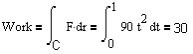
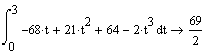
Ex 7 Evaluate the following line integral for each parametrization of the parabolic curve. Does the result seem logical?



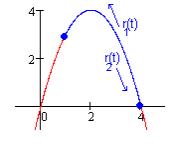
For  ,
,
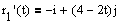 and
and 
The line integral is
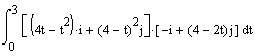
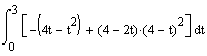
For the path  ,
we have
,
we have 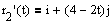 and
and
 . The line integral is
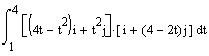
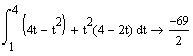
Note that in the above example, the change of direction altered the sign, but the absolute value of the line integral was the same. If you were calculating the work needed to push a rocket out of Earth's gravitation field and compare to the work required to slow the rocket to a stop on its descent, the work would be the negative of the work to launch it. Of course, coming back to Earth would require some sort of retro-firing rocket, and the problem is similar to the one above. The descents are not controlled in this way in reality. Parachutes or actual controlled flight in the space shuttle is how that part of a round trip into space is achieved.
Line Integrals in Differential Form
A second commonly used form for line integrals can be derived from the vector
field notation in the previous section. If we let  be
a vector field and
be
a vector field and  be
a curve in space, then
be
a curve in space, then  is
often written
is
often written  or
if in a 2D plane,
or
if in a 2D plane,  .
To see this, look at the following:
.
To see this, look at the following:

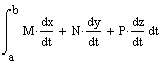
The two dimensional variation of this is:
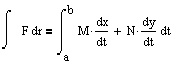
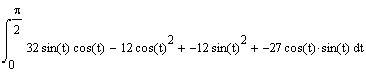
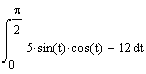
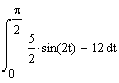
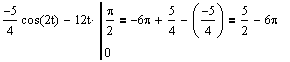
Ex 8 Evaluate the line integral in differential form
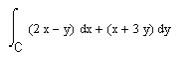
where C is the elliptical path x = 4sin(t),y = 3cos(t)
from (4,0) to (0,3).

Ex 9 Evaluate the line integral
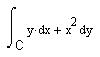
where C is the parabolic path  from
(4,0) to (1,3) without converting to t as parameter.
from
(4,0) to (1,3) without converting to t as parameter.
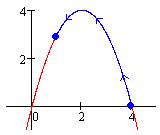
As an option, we can do this without converting to parameter t since dy = (4-2x)dx, so the integral is

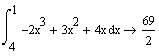
Compare this with Ex 7 above to see the result. A different orientation would change the limits and give the negative answer as in Ex7.
Assignment 15.2 # 1,3,5,7,9,13,17,19,23,29,33,35,41,45,55,82,85