15.1 Vector Fields
Def Vector Field
Vector fields: definition and examples of vector fields 

Inverse square fields and examples, a plot of a vector field
Another example of a vector field, conservative vector fields.
Conservative vector fields, example, show that an inverse square field is conservative.
Test for conservative vector fields and an example.
Finding the potential function for a conservative vector field example.
Curl of a vector field defined, a computation memory device and an example.
Curl and conservative vector field in space with two examples including finding a potential function.
Divergence of a vector field defined and an example.
Connection with divergence and curl.
A vector field on a domain in the plane or in space
is a function that assigns a vector to each point in the domain. A field of
2D vectors would look like this:  and
a field of 3D vectors would look like this:
and
a field of 3D vectors would look like this:  .
.
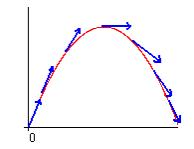
If we can imagine attaching a projectile's velocity vector at each point on its trajectory in the plane of motion, then we have a 2D vector field defined on the trajectory as shown:
If you can imagine the gradient vector at each point on all level surfaces
of a function of three variables, then we have a 3D vector field. Naturally
a gradient vector at each point of all level curves of a function of two variables
creates a 2D vector field. These would both be extremely hard to
draw! 
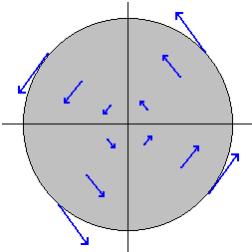
1.Velocity fields describe the motion of a particle in the plane or space. An example would be velocity vectors determined by a rotating disk like a CD or a wheel. Note the further from the center, the longer the velocity vector as you would expect. Those points are travelling faster.
2. Gravitational fields: Newton's Law of gravitation, stated in layman's terms, states that particles attract each other based on their distance from each other and their mass. The formula for the force of attraction exerted on a particle of mass m1 at (x,y,z) by a particle of mass m2 located at (0,0,0) is:
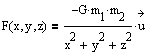
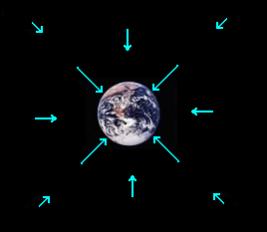
where G is the gravitational constant and u is a unit vector and points from the origin to (x,y,z). In this drawing, I put vectors representing gravity pulling towards Earth's center (the origin).
3. Electrical force fields. Coulomb's law involving static electricity states that charged particles attract each other in amounts based on their distance from each other and the amount of charge. Really it is no different from Newton's Law above:
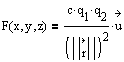
where F is the force generated, q1 and q2 are the charges on the particles, c is a constant (for the medium) and r the distance between the particles. If one was at the origin and one at (x,y,z), then the denominator would be x2+y2+z2 as in Newton's Law.
Both 2 and 3 are examples of inverse square fields.
Def Inverse Square Field
Let r(t)=x(t)i+y(t)j+z(t)k be a vector valued function. The vector field F is an inverse square field if
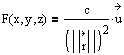
where c is some real number and u is a unit vector in the direction of r.
Gravitation fields as well as static electrical fields are both examples of this.
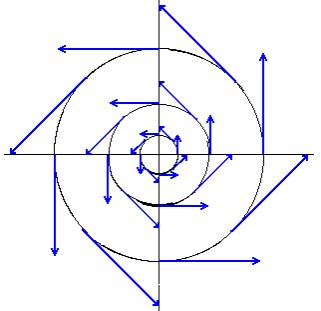
Ex 1 Sketch some vectors in the vector field: F(x,y) = -yi+xj. Just plot some vectors at some of the points in the plane. The sketch will show better information if we plot vectors of uniform length where appropriate. Keep in mind there are vectors at every point in the plane. I am drawing a few that are on circles for convenience sake.
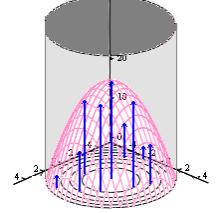
Imagine that liquid is flowing through a pipe of fixed diameter. The fluid flows with greater velocity near the center, and with less velocity near the edge. The following example could be a model for such a situation:
Ex 2 Sketch some vectors in the velocity field  where
where
 .
.
 is
a circular cylinder along the z axis. At the center, we have the vector 25k,
at the edges, the vectors are near 0 in length. All are pointing upwards.
The sketch follows. Note that the mesh (salmon color) is really just showing
the graph that would touch the tips of the vectors sketched from the xy plane.
Velocity vectors exist at all points within the pipe,
these are just the ones in a particular plane.
is
a circular cylinder along the z axis. At the center, we have the vector 25k,
at the edges, the vectors are near 0 in length. All are pointing upwards.
The sketch follows. Note that the mesh (salmon color) is really just showing
the graph that would touch the tips of the vectors sketched from the xy plane.
Velocity vectors exist at all points within the pipe,
these are just the ones in a particular plane.
In the example above, it looks like the vectors are normal to the level curves from which they emanate. This is a property of gradients. Some vector fields are really just fields of gradients for a differentiable 'scalar' function f. Those vector fields that are fields of gradients for a differentiable 'scalar' function f are called conservative.
Conservative Vector Fields
Def Conservative Vector Field, Potential Function
A vector field F is called conservative
if there is a differentiable function f such that F =  .
The function f is called the potential function for F.
.
The function f is called the potential function for F.
Ex 3 The vector field F = 2xi+2yj is conservative.
F is the gradient
for f(x,y) = x2 + y2 since  =F.
=F.
Ex 4 Show that every inverse square field is conservative.
Let the field F and the function f be defined as

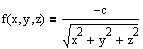
where u is defined as r/||r||, some unit vector.
Note that
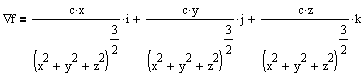

Since 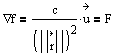 ,
F must be conservative. The
function f is the one given above.
,
F must be conservative. The
function f is the one given above.
Theorem 15.1 Test For Conservative Vector Fields in the Plane
Let M and N have continuous first partial derivatives on an open disk R. The vector field given by F(x,y) = Mi+Nj is conservative if and only if

Ex 5 Show that the vector field is conservative:

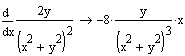
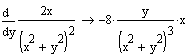
This vector field is conservative since

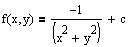
Ex 6 Find the potential function for the example above.
Note that the partial derivative with respect to y is the N and the partial derivative with respect to x is the M. Integrating M with respect to x and N with respect to y gives:
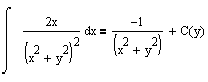
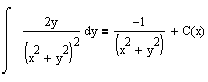
If both constants of integration are merely numbers (as they must be in this case), then letting that number = c yields the function.
The 3D space version of theorem 15.1 involves something called the curl of a vector field.
Curl of a Vector Field
Def Curl of a Vector Field
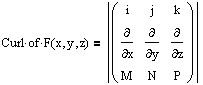
The curl of F(x,y,z) = Mi+Nj+Pk is defined as


If this happens to be the zero vector, we say F is irrotational.
The notation in the definition  comes
from viewing the gradient as the result of a differential operator
comes
from viewing the gradient as the result of a differential operator  acting
on the function f. This determinant can act as a memory aid for the formula
above for curl:
acting
on the function f. This determinant can act as a memory aid for the formula
above for curl:
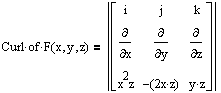
Ex 7 Find curl F of the vector field, and evaluate at (2,-1,3)



There is a physical significance of curl. It comes later in this unit in lesson 8.
Theorem 15.2 Test For Conservative Vector Fields in Space
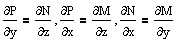
Let M,N and P have continuous first partial derivatives on an open sphere Q. The vector field given by F(x,y,z) = Mi+Nj+Pk is conservative if and only if
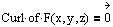
In other words, F is conservative in space if and only if
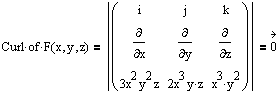
Ex 8 (A) Determine whether or not F is conservative. If it is, find a potential function for F.

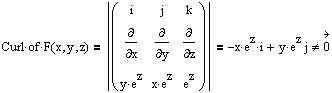
(B) Determine whether or not F is conservative. If it is, find a potential function for F.

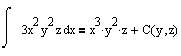
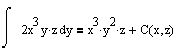
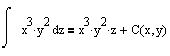
The potential function is such that all of the constants above are equal, call it C
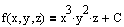
Note that the curl of a vector field is itself a vector function. The next thing in our discussion is a scalar function.
Divergence of a Vector Field
Def Divergence of a Vector Field
The divergence of F(x,y) = Mi+Nj is
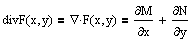
and the divergence of F(x,y,z) = Mi+Nj+Pk
is 
If div F = 0, then F is said to be divergence free.
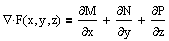
The dot product in the notation  comes
from considering
comes
from considering  as
a differential operator as follows:
as
a differential operator as follows:

Ex 9 Find the divergence of the vector field at the point (2,-1,3)



There are important properties of the divergence and curl of a vector field. One often used is in the following theorem:
Theorem 15.3 Relationship Between Divergence and Curl
If F(x,y,z) = Mi+Nj+Pk is a vector field and M,N, and P have continuous second partial derivatives, then div (curl F) = 0.
Note in #71 below since curlF is itself a vector, you can find curl(curlF).
Assignment 15.1 #1-6, 9,23,29,35,43,51,57,61,69,71,77,81, and read problems 83-90 (to see properties of divergence and curl)