13.7 Tangent Planes and Normal Lines
Tangent Plane and Normal Line to a Surface
Surface as a level surface and a graph. 

Normal line to a surface, tangent plane to a surface, an example and a graph.
Tangent plane to the graph of a function of two variables at a point, and a graph.
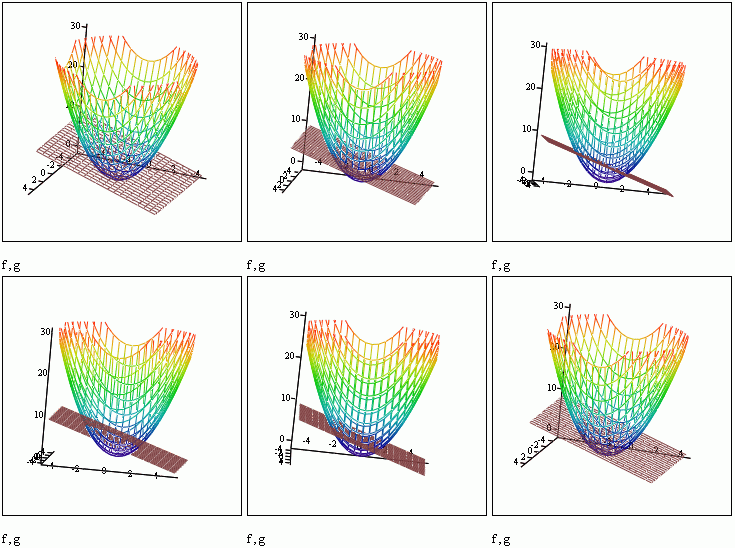
Example of a normal line to a surface at a point, symmetric and parametric and a graph.
Find the equation of the tangent line to the intersection of surfaces at a point, cosine of the angle between gradient vectors and tell whether the surfaces are orthogonal at the point.
Angle of inclination of a tangent plane to a surface.
One more example of a tangent plane with a graph.
Suppose we have a surface S generated by z = f(x,y). We can represent it as f(x,y)-z = 0, or F(x,y,z) = 0 if we wish. Hence we can consider the surface S to be the level surface of F given by F(x,y,z) = 0.
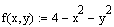
Ex 1 For the function F(x,y,z) = x2 + y2 + z - 4, describe the level surface given by F(x,y,z) = 0.
We just have the surface z = 4 - (x2 + y2)
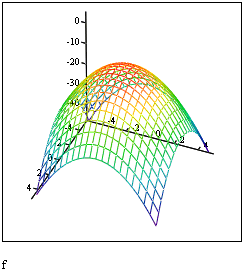

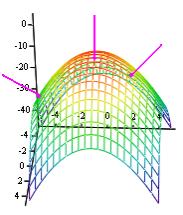
A normal line to this surface at a point P(x0,y0,z0) would be a place where when struck at P by a ball travelling along the normal line, the ball would bounce directly back the path it came in on. (If there was no gravity pulling it down!!) There are three normal lines drawn in purple on the graph here at different points.
Note that if we can find a normal line at a point on a surface, that we
can also find the plane that the line is normal to, in other words the tangent
plane to the surface at a point.
Let S be a surface given by F(x,y,z) = 0, and P(x0,y0,z0) be a
point on the surface S. Let C be a curve on the surface S that goes through P with C defined by vector-valued function r(t) = x(t)i + y(t)j + z(t)k. Since C is on the surface, F(x(t),y(t),z(t)) = 0. Suppose F is differentiable and x'(t),y'(t), and z'(t) all exist. From the chain rule we would get F'(t) = Fx(x,y,z)x'(t) + Fy(x,y,z)y'(t) + Fz(x,y,z)z'(t) = 0 since F(x,y,z) = 0. This is equivalent to
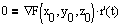
This means the gradient at P is orthogonal to the tangent vector of every curve on S through P. All of these tangent lines at P lie in a plane normal to the gradient that contains P.
Def: Tangent Plane and Normal Line
Let F be differentiable at the point P(x0,y0,z0) on the
surface S given by F(x,y,z) = 0. such that the gradient at P is not the zero vector.
1. The plane through P that is normal to the gradient vector at P is called the tangent plane to S at P.
2. The line through P having the direction of the gradient at P is called the normal line to S at P.
To find the equation of the tangent plane to S at P, let (x,y,z) be an arbitrary point in the tangent plane. Then the vector

lies in the tangent plane. Since the gradient is normal to this vector in the tangent plane, we have
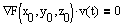
Theorem 13.13 Equation of the Tangent Plane
If F is differentiable at (x0,y0,z0) then an equation of the tangent plane to the surface F(x,y,z) = 0 at (x0,y0,z0) is given by

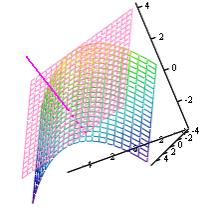
Ex 2 Find the equation of the tangent plane at (0,2,0) to the paraboloid: (sketch it!)




The tangent plane is  ,
simplifying to 4y + z = 8.
,
simplifying to 4y + z = 8.
Here's a sketch:

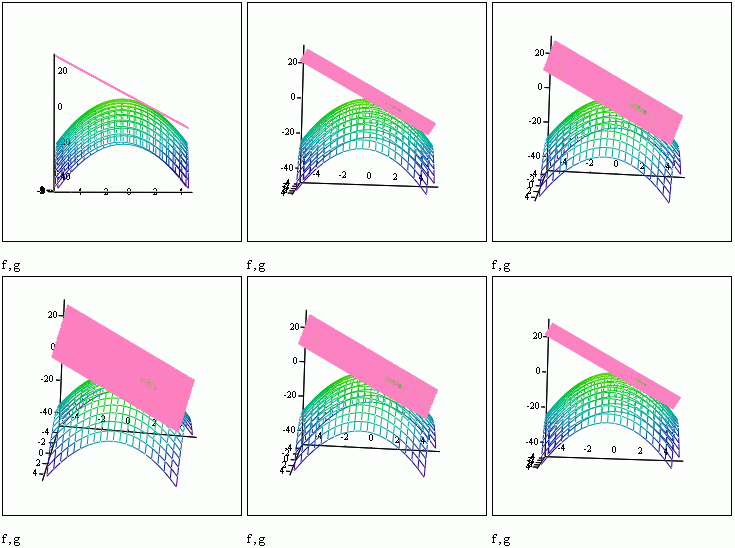
Note that this example shows that in general when given a function of the form z = f(x,y) that the equation of the tangent plane will simplify a bit to

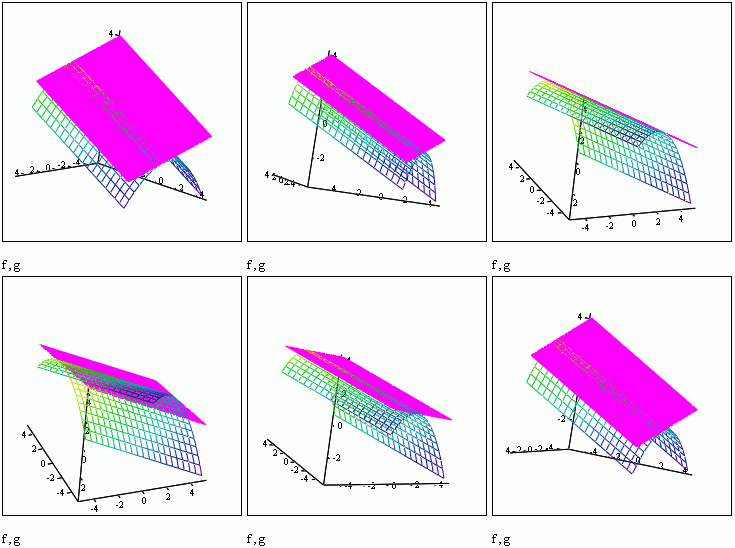
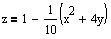
Ex 3 Find and sketch(!) the equation of the tangent plane to the graph of the function at the point (1,1,1/2):
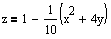
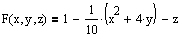
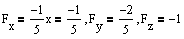

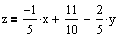
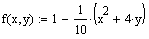
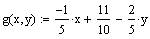
Ex 4 What is the equation of the normal line to the surface at the point (1,1,1/2)? (some of the work is from the above example on the gradient) Sketch (!)
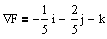
We have direction numbers -1/5,-2/5,-1 and the point (1,1,1/2), so the line is
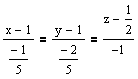
or simplified a bit, we get the symmetric equation
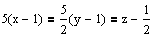
and the parametric equations would be 
Knowing that the gradient  (x,y,z)
is normal to the surface F(x,y,z) = 0 allows solution to some geometry problems
in R3. Here's a complicated one!
(x,y,z)
is normal to the surface F(x,y,z) = 0 allows solution to some geometry problems
in R3. Here's a complicated one!
Ex 5 Find the symmetric equations of the tangent line to the curve of intersection of the surfaces in R3 at the point (2,-1,5) and also find the cosine of the angle between the gradient vectors at the point. State whether or not the surfaces are orthogonal at the point of intersection.
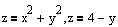




The cross product of these normal vectors will give the direction numbers of the required tangent line.
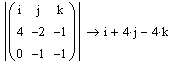
The tangent line is 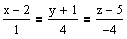
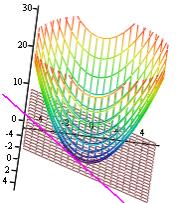
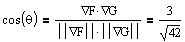
Not orthogonal at intersection point.
The Angle of Inclination of a Plane
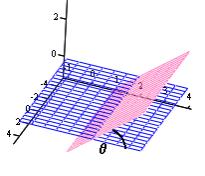
Another use of the gradient vector is to determine the angle of inclination of a tangent plane to a surface. The angle of inclination is defined as the angle between the given tangent plane and the xy plane, values to fall in the interval [0,p/2] 0 would mean horizontal and p/2 would mean perpendicular to the xy plane. Since the vector k is normal to the xy plane, we can use the formula for cosine of the angle we used in the last example:
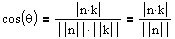
Here is a picture describing this
Recall that we saw in the last section that the gradient vector at point P was normal to the level curve that went through the point P. This can be extended to functions of three variables:
Theorem 13.14 Gradient is Normal to the Level Surface
If F is differentiable at (x0,y0,z0) and the gradient vector at that point is not the zero vector, then the gradient vector at P is normal to the level surface at P.
Ex 6. Find the equation of the tanget plane to f(x,y)=y/x at the point (1,2,2).
Ex 7. Find the equation of the tangent line to the intersection of the surfaces
z = x2+y2 and x + y + 6z = 33 at the point (1,2,5)
Assignment Pg 949 #1,3,7,11,15,19,25,29,33,41,49