12.2 Differentiation and Integration of Vector Valued Functions
Derivatives of vector valued functions. 

What is the derivative of a vector valued function?
Doing a lot of thinking about higher order derivatives.
Smooooooth curves and an 'epicycloid'.
Properties of derivatives of vector valued functions.
Examples using the properties.
Proof that if the dot product of two vector valued functions is a constant, then the dot product of the vvf and its derivative is 0.
Integration of vector values functions is linear, and a couple examples.
Def: Definition of the Derivative of a Vector Valued Function
The derivative of a vector-valued function r is defined as:
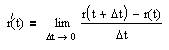
for all t for which this limit exists. If r'(c) exists, then r is differentiable at c. If r'(c) exists for all c in an open interval I, then r is differentiable on I.
Theorem 12.1 Differentiation of vector valued functions
If r(t) = f(t)i + g(t)j + h(t)k where f, g, and h are differentiable functions of t, then r'(t) = f '(t)i + g'(t)j + h'(t)k. For the version in R2 ignore the k part.
In other words, just take the derivative of each of the component functions.
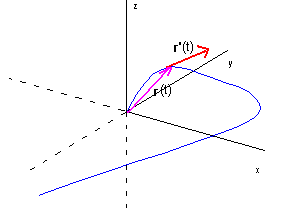
An important geometric feature of this derivative is that the result r'(t) is a vector tangent to the curve and pointing in the direction of increasing parameter t. The picture shows the vector r(t) in purple, and r'(t) in red. The path of the vector-valued function is blue.

Ex 1 (too easy!) Find the derivative of each vector-valued function:
a) r(t) = (2t - 5)i + (3t2 + t)j
b) r(t) = et sin(t)i + et cos(t)j -ln(t)k
Note any restrictions on t also.
(a) r'(t) = 2i + (6t+1)j t could be anything
(b) r'(t) = (etcos(t)+etsin(t))i
+ (etcos(t)-etsin(t))j -(1/t)k, t must greater
than zero.
Note that higher order derivatives are merely derivatives of derivatives, so you should already know how to do that.
Ex 2 Given r(t) = cos(t)i + sin(t) j + 2t.k, find
r'(t), r''(t), r'(t).r''(t) and r'(t)xr''(t). Recall which is a vector and which is a scalar.
r'(t) = - sin(t)i + cos(t)j + 2k
r''(t) = - cos(t)i - sin(t)j
r'(t).r''(t)
= sin(t)cos(t) - cos(t)sin(t) + 0 = 0 

r'(t)xr''(t)
= 2sin(t)i - 2cos(t)j + k
The dot product is a scalar, all else are vectors.
Def : The parametrization of the curve represented by the vector-valued function r(t) = f(t)i + g(t)j + h(t)k is smooth on the open interval I if f ', g' and h' are continuous on I and r'(t) is not = 0 for any t in I.
Ex 3 Find the intervals where the epicycloid curve C is smooth:
(Note an "epicycloid" is made from rolling a small circle around a bigger one. The Curve traced by a point on the smaller circle is an epicycloid.)
C is traced by the vector-valued function r(t) = (5cos(t) - cos(5t))i + (5sin(t) - sin(5t))j. Our concern is the places where r'(t) = 0 since f ' and g' are continuous everywhere.


Now we must solve the two equations f ' = 0 and g' = 0


By inspection (This is too ugly using algebra and
trig identities! I would have to derive the ones for sin(5t) and cos(5t))
t = 0, p/2,
p,
3p/2,
2p
are places where r'(t) = 0.
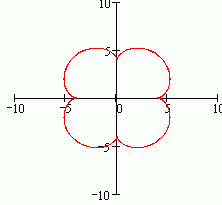
The curve is smooth on (0,p/2), (p/2,p), (p, 3p/2), (3p/2, 2p) on one cylce through [0, 2p] The graph shows the smooth parts and the non-smooth parts are at the axes intersections.
Theorem 12.2 Properties of the Derivative:
Note most of these appear in Calculus I, but the format differs!
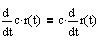
Assume r(t) and u(t) are vector-valued functions, and f(t) is a scalar function. Nothing special here you don't already know, just be careful to distinguish vector answers from scalar.
1. 
2. The sum rule: 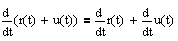
3. The Product Rule for a scalar function
multiplication:  (Note the result is a vector.)
4. The Product
Rule for the dot product: (Note the result is a scalar.)
5 .The x is
the cross product : 
6. A type of chain rule: 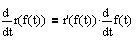
7. If r(t).r(t)
= c then r(t).r'(t) = 0
Ex 4 Given the vector-valued functions, find each for the r(t) and u(t) where

a) The derivative sof r(t)
and u(t) 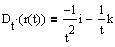 ,
, 
b) The derivative of the
dot product of r(t) and u(t):


simplifying
to 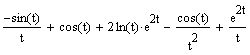
Ex 5 Show that if r(t).r(t) = c, then r(t).r'(t) = 0 i.e. prove 7.
Let r(t) = x(t)i + y(t)j + z(t)k.
If r(t).r(t) = c, then (x(t))2 + (y(t))2 + (z(t))2 = c .
Differentiating both sides of this equation (with the chain rule) gives
2x(t)x'(t) + 2y(t)y'(t) + 2z(t)z'(t) = 0
The left side of this expression is twice the dot product r(t).r'(t), hence we have shown r(t).r'(t) = 0.
Integration of Vector-Valued Functions
Definition of Integration of a vector-valued function r(t):
Note the linear nature of the integral (the integral of a sum
equals the sum of the integrals) gives us this in a logical way:


Ex 6 Integrate the following vector-valued function:
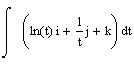
since 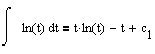
The answer is 
Where C is the constant vector c1i
+ c2j + c3k.
Ex 7 Evaluate the definite integral:

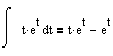
Using integration by parts, u = t, dv = etdt.
The answer is 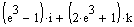
Ex 8 Here are several other examples.
Assignment: 12.2 # 1, 3, 5, 7, 9,11,17,19,27,29,33,36,39,45, 49, 57, 63, 67 (r(0)=2i lets us solve for the constants), 69,77, 86